|
|
|
Most
companies are looking for ways to cut costs. One way is through better
management of materials in storage silos. Many companies
still use just point level sensors, like a “paddle
unit”, to let them know when the material in the silo is high
or low. Besides detecting high and low levels, a continuous level
sensor, like the SiloPatrol® SE cable-based level sensor, can
actually help cut costs and even increase personnel safety by automating
inventory control. Although a continuous level inventory measurement
system sounds like a good idea, the inclination may be that “a
point level works ok, no need to spend any money to upgrade or change.” So
how does one justify the extra initial cost of a continuous level
system?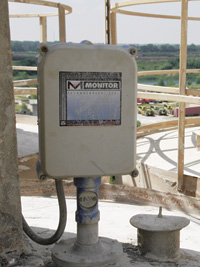
A company in Northern Illinois with 13 silos who
provides pre-blended masonry products and automated mixing stations
to construction sites was
looking for a way to better control the inventory levels of their
raw materials instead of having to do a “visual”. They
are very proactive in trying to find ways to make themselves more
cost-efficient and effective on all levels of operation. After some
research they decided to go with the SiloPatrol® cable-based
smart sensor (SMU) with the SiloTrack inventory management software
from Monitor Technologies. Even though the system cost more than
they initially were willing to spend, they were able to justify the
expenditure because of the added benefits of time saved to manually
measure the material levels and for the personnel safety reasons.
Now with automatic or on-demand readings, they have better control
of when they need to re-order raw materials and when the silos are
getting full during refilling to prevent the downtime and clean-up
costs of an over-filled silo. Plus, personnel make a lot fewer trips
up the silos.
Their initial purchase was for 6 SMU’s and the SiloTrack software.
Once they realized the value of the continuous level measurement
system, they were able to justify the purchase
of additional SMU’s
for more of their silos.
Other features that they have
come to appreciate about the SiloPatrol is the simplicity of installation
(including wiring and set-up) for the sensor and the software,
that the software works with the current PC on their desk, the
sensor’s compartmental
isolation of the electrical and mechanical components which eliminates
much of the dust from going into the electrical area, and the ability
to replace the sensor’s wiper and brush that cleans the cable
without having to actually cut the cable for servicing. They also
mentioned that technical support has been very responsive. They once
had a computer board issue that caused software re-installation problems
and technical support spent the time to talk them through the issue
and shared knowledge for future prevention.
The SiloPatrol SE inventory management system is the second edition
of the industry-leading cable-based smart sensor system that is designed
to handle some of the harshest and most dynamic conditions imaginable.
The SiloPatrol SE system incorporates state-of-the-art sensors with
a wide choice of operator interfaces to fit all types of situations.
More
Information on SiloPatrol® SE Inventory Monitoring System
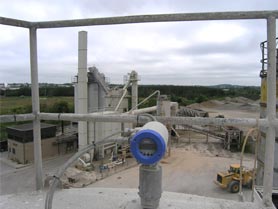 Hogg
Fuel & Supply operates concrete batch plants in Ontario,
Canada. Hogg Fuel has been a quality supplier of ready mix
concrete for over thirty (30) years. They use a blend of Portland
cement and slag. The “slag” is actually GGBS or
ground granulated blastfurnace slag. GGBS is sometimes used
as an additive to concrete to provide benefits in the areas of durability,
quality, strength and finish. Typical batches include about
10-15% slag but this can vary depending on the need of their customer. Hogg
Fuel & Supply operates concrete batch plants in Ontario,
Canada. Hogg Fuel has been a quality supplier of ready mix
concrete for over thirty (30) years. They use a blend of Portland
cement and slag. The “slag” is actually GGBS or
ground granulated blastfurnace slag. GGBS is sometimes used
as an additive to concrete to provide benefits in the areas of durability,
quality, strength and finish. Typical batches include about
10-15% slag but this can vary depending on the need of their customer.
Maintenance Supervisor Bob Knarr was looking to replace the older
weight & cable units installed on their 20ft (6.1m) cement and
slag storage silos. Although the weight & cable based technology
provided accurate distance measurements, they required maintenance
several times per year. Bob and Hogg Fuel wanted a measurement
system that would be would not require maintenance, would provide
true continuous readout, provide the accuracy they require, while
retrofitting into the existing mounting portals on top of their silos.
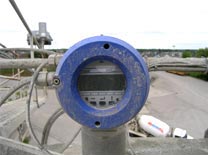 This
plant was designed as an auxiliary plant to their main facility and
therefore was built with smaller capacity silos than their main plant. However,
this auxiliary plant has become increasingly busier in recent years.
This makes tracking the level critical as loads are required more
frequently than in the past. This
plant was designed as an auxiliary plant to their main facility and
therefore was built with smaller capacity silos than their main plant. However,
this auxiliary plant has become increasingly busier in recent years.
This makes tracking the level critical as loads are required more
frequently than in the past.
Flexar has met all of their expectations and system requirements. As
with all complete systems, Hogg Fuel has a rotary paddle point level
unit top mounted with a two foot extension for indication of high
level to alert the cement delivery to shut down when the vessel is
full. As an added bonus, Flexar provides the batcher in the
control room the ability to track the progression of the fill cycle
right to its completion! The Flexar sensors were installed
in late April 2006.
Flexar is a guided wave radar continuous level sensor. Distance/level is
measured by the time-of-flight of the reflection of a microwave signal (transmitted
down the wave-guide, which is a heavy-duty 0.3” SS cable with 3.9 ton tensile
strength) off the material surface. Cement and GGBS slag both have relatively
low dielectric constants and Flexar’s direct measuring mode
was successful in providing real-time continuous updates of the material
level during filling and draw-down.
More
Information on Flexar® Guided Wave Radar
|
|


 Mobile
View
Mobile
View