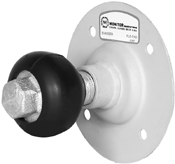
The Evasser bin aerator from Monitor Technologies
is an aeration device used to promote the fluidization and flow of dry bulk powders
from a storage vessel (bin, silo, hopper) without the noise and damaging vibration
caused by pneumatic or electric vibrators. The Evasser aerator
is small, compact and capable of aerating many types of bulk
powders and granular solids in bins, hoppers and silos. The
Evasser can discharge air up to 80 psi (5.5 bar) to move
settled materials. Once material is flowing the Evasser can
be used to maintain flowability of material with a constant
2 to 5 psi (0.14 to 0.35 bar) supply of air.
Unlike other types of aerators that use cotton or canvas
to diffuse the air, the Evasser is less likely to be bound
or clogged due to moisture and can be more effective as it
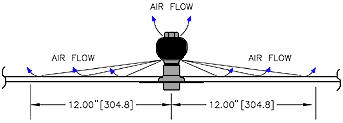
directs air flow to 'sweep' the bin wall. In addition, the
Evasser is not as prone to back-flow of material as the standard
neoprene boot expands to let the pressurized air out and
contracts when the air is shut off blocking the air outlets
from material backflow.
The Evasser bin aerator is available with a convenient
external mounting plate. This means that installation of
the device can be done from outside of the bin making it
ideal for use in replacing worn and plugged air pads. In
addition, with no moving parts or filters to clean or replace
the Evasser requires virtually no maintenance.
The single Evasser bin aerator
operates by continuously introducing air into a mass of
stored powder.
When first
conveyed into
a storage vessel, the powder is a highly aerated mixture
of air and particulate. In this state, the mixture flows
quite
easily. As the material settles, the particulate and air
separate. The material decreases in volume and increases
in density (it
packs), and in turn it begins to behave like one solid
mass rather than a fluid mixture of particles. The Evasser
replaces
the naturally lost air and increases and maintains the
air-to-particulate mixture ratio, thus allowing the material
to flow.
The most effective aeration of dry bulk materials is
typically achieved by the use of four rows of Evassers, one
row located in each quadrant of the slopping bin bottom.
With aerating dry powders the Evassers will normally be spaced
18in on centers, with the lowermost units located close to
the outlet where most of the bridging starts. On granular
materials the location of the Evassers will vary with the
material being aerated and the configuration of the bin.
In all cases, please consult with the Monitor application
engineers that are ready to provide you with the best recommendation
for your specific material flow problem.
Typical
Applications include, but are not limited to:
Cement
Bentonite
Gypsum
Soda
Ash
Lime
Flour
Carbon
Black
Fly
Ash
Other
Features
Typical
effective radius of 12 inches (305mm)
Compact and low cost with virtually no maintenance
Available in cast iron or 316 stainless steel
Black Neoprene boot or optional white FDA Neoprene
boot
Accessories
The Evasser bin aerator is available in several
configurations. The Evasser itself can be provided in either
cast iron or 316 stainless steel construction. The Evasser
is normally supplied with a black Neoprene boot. A FDA approved
white boot is also available. For high pressure or high temperature
applications where the boot is not acceptable, a sintered metal
insert can be provided. In addition, each of these configurations
can be provided with or without the external mounting plate.
Specifications
Air
Supply/Consumption:
Air
Supply :
Continuous
clean, dry air 3 to 5 psid (0.2 to 0.35 bar)
(the difference between the air feed pressure
and the internal vessel pressure)
Air
Consumption:
Typically
3 psi (0.2bar) / 3 scfm (0.085m³/min)
Materials
of Construction:
Body:
Cast
iron (Option 1, 1A, 3 and 3A)
316 stainless steel (Option 1SS, 1ASS, 3SS and 3ASS)
Cork
(up to 175°F/80°C) for mild steel mounting
plate
White Nitrile (up to 175°F/80°C) for
stainless steel mounting plate
Boot
(standard):
Black
Neoprene (up to 175°F/80°C)
Boot
(optional FDA):
White
Neoprene (up to 175°F/80°C)
Sintered
Metal Insert (optional):
Bronze
90 micron (up to 900°F/480°C) or 40 (optional)
micron filter for extra fine materials (up to
900°F/480°C)
Air
Inlet Connection:
1/2" NPT
coupling
Warranty
Monitor Technologies warrants each evasser
it manufactures to be free from defects in material and workmanship
under normal use and service within two (2) years from the
date of purchase. The purchaser must notify Monitor of any
defects within the warranty period, return the product intact,
and prepay transportation charges. The obligation of Monitor
Technologies LLC under this warranty is limited to repair
or
replacement at its factory. This warranty does not apply
to any product which is repaired or altered outside of Monitor
Technologies' factory, or which has been subject to misuse,
negligence, accident, incorrect wiring by others, or improper
installation.
Updated November 2017
QuantiMassTM
Mass Flow Measurement Systems
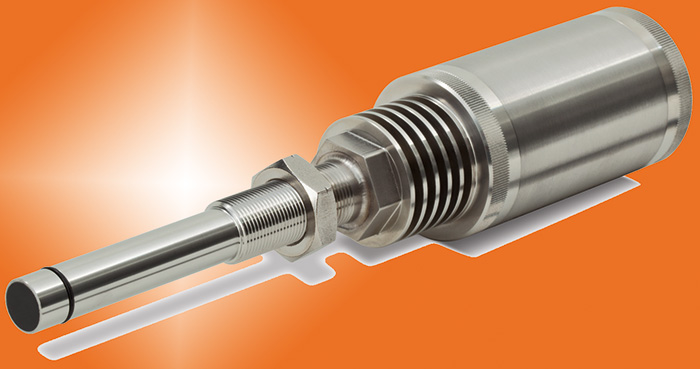
The QuantiMass in-line mass flow sensor measures the flow of quantities in pneumatic conveying & free-falling processes. The sensor is based on the latest Microwave Doppler Effect technology and provides fast, in-line / on-line measuring without the use of weight scales.
The sturdy, non-intrusive design of the sensor minimizes maintenance. In addition, the compact size of the sensor makes for easy installation into existing processes. Suitable for powders, dust, pellets, and granular up to 0.75 inch (2cm).
Versions:
Ultra Series-Includes controller
PRO Series-Includes transmitter
A practical application for the QuantiMass would be to monitor material flow rates to verify blending mixture ratios.
Principle of Operation:
The QuantiMass Mass Flow Measurement Sensor / Meter is designed with the latest microwave technology and is used to continuously quantify the flow of powders & solids being conveyed in metallic pipes. The QuantiMass is based on technology that has been developed and proven over several years. The measurement process of the sensor is centered on the Doppler effect. The mass flow-rate is determined by evaluating the frequency and amplitude changes during the measurement process. Particles at rest, such as deposits, do not influence the measurement. All powders, dust, pellets and granules can be measured reproducibly, up to the size of 0.75 inch (2cm). The QuantiMass sensor is suitable for continuous in-line / on-line measurements in pneumatic conveying or in free-fall pipelines.


 Mobile
View
Mobile
View